

Exit Ticket: August 2025
9 books to read and 39 daily poems for teaching AP Lit (or for anyone else who needs more poetry in their life, aka EVERYONE)


You know school has started when my monthly reading list is in the single digits! I’m back in the classroom full-time for the first time in five years, and I’m feeling (as my kids say) cooked.1 But as I told parents at back-to-school night, I enjoy teaching because I get to talk about literature and writing every single day.2
9 Books to Read
The Perfect Golden Circle by Benjamin Meyers — Read my full review here.
Interior Chinatown by Charles Yu — Told in the format of a screenplay, Interior Chinatown follows Willis Wu, who lives in Chinatown but dreams of life beyond the neighborhood—and the stereotypes that go with it. Willis believes that moving up the Hollywood ranks from Generic Asian Man bit parts to Kung Fu Master stardom will bring him success and happiness, but it turns out that life doesn’t always match the script.
I Want to Burn This Place Down: Essays by Maris Kreizman — If you love books and don’t subscribe to The Maris Review, go do that right now! I first found Kreizman here on Substack, I think. She moved to a different newsletter platform, but I still read her with regularity. She draws on her long experience in the publishing industry for much of I Want to Burn This Place Down, part of which recounts her efforts on the HarperCollins picket line, fighting for livable wages. (Read an excerpt on LitHub here.) She also writes candidly about her experience with type one diabetes and calls attention to the many ways our American healthcare system lets down people with chronic illnesses. I highly recommend the audiobook, which she narrates herself.
A Marriage at Sea: A True Story of Love, Obsession, and Shipwreck by Sophie Elmhirst — For the record, Elmhirst’s unbelievable account was on my list long before Stephen Colbert brought it to “The Late Show Book Club,” but hey, I guess I’m in good company! Elmhirst tells the story of Maurice and Maralyn, an unconventional British couple who survive months at sea in a tiny life raft when a whale capsizes their boat.3 I found myself happily running errands because I couldn’t wait to hear what happened next. If you like The Wager by David Grann or Endurance by Alfred Lansing, give this one a try.
The Fire Concerto by Sarah Landenwich — Thanks to my friend Claudia for saving me from the long library waiting line on this title! I really enjoyed this novel about Clara Bishop, a former concert pianist who hasn’t played since she was burned in a horrible fire. When her former piano teacher dies and leaves Clara a mysterious metronome associated with a famous Romantic composer, Clara must investigate to learn the truth, both about the metronome and herself. In case you’re on the waitlist at your library for this one, I recommend listening to this old episode from RadioLab about Beethoven’s unusual metronome markings.
The Round House by Louise Erdrich — Rereading this book was easily my best decision of the month! If you’ve never read Louise Erdrich, please accept this gentle admonition to stop. everything. right. now. and go read one of her books. I adore Love Medicine and The Last Report on the Miracles at Little No Horse and The Night Watchman, but really, you can’t go wrong with anything by Louise Erdrich. The Round House tells the story of Joe Coutts, a young man who lives on a reservation in the ‘80s and whose life is upended the summer his mother is raped. Because the crime occurred where tribal, state, and federal land converge, the jurisdiction is unclear. As Joe watches his mother suffer and his father, a tribal judge, seek justice for her, he must determine the boundaries for his own morality. It’s a gut-punch of a novel that you really should read.
Exit Zero by Marie-Helene Bertino — As we’ve established, I’m a big fan of Marie-Helen Bertino! Her short story collection is as quirky as I expected. One character is stuck in a Cheers episode; another character receives message-laden balloons from the sky as she gardens. Each story left me wanting more, which I think is pretty much the point of short stories. (Also: read Beautyland!)
Crying in H Mart by Michelle Zauner — Technically I didn’t read Zauner’s memoir this month, but seeing as it was my book club’s August pick, I figured Crying in H Mart needed a shout-out. I listened to the audiobook a couple of years ago and loved it. You may know Zauner from her musical life in Japanese Breakfast (I did not), but you don’t need to know anything about her before reading this account of her relationship with her mother and her Korean heritage. Much of the memoir focuses on Zauner’s attempts to recreate her family’s Korean dishes.
Zauner writes, “I remember these things clearly because that was how my mother loved you, not through white lies and constant verbal affirmation, but in subtle observations of what brought you joy, pocketed away to make you feel comforted and cared for without even realizing it. She remember if you liked your stews with extra broth, if you were sensitive to spice, if you hated tomatoes, if you didn’t eat seafood, if you had a large appetite. She remembered which banchan side dish you emptied first so the next time you were over it’d be set with a heaping double portion, served alongside the various other preferences that made you, you.”
I’ve recommended this book to a number of students, and those who read it agree with me: You should read it.
The Place of Tides by James Rebanks — Years ago, my husband and I listened to Rebanks’ first memoir, The Shepherd’s Life, while on a road trip. In his latest book, Rebanks trades his native England for the northern islands of Norway, where he spends a spring with Anna, who is working her last season as a duck woman. Alongside Anna, Rebanks learns to build nests for eider ducks, live quietly while they nest on the island, and collect their feathers for use in eiderdown duvets. This book is at once a celebration of a traditional Norwegian way of life, a warning about our overstressed oceans, and Rebanks’ own journey of self-reflection and forgiveness. As a bonus, Anna makes lefse, which delighted me so much because it’s a Norwegian treat my friend and I make every year.
39 Poems to Read in AP Lit
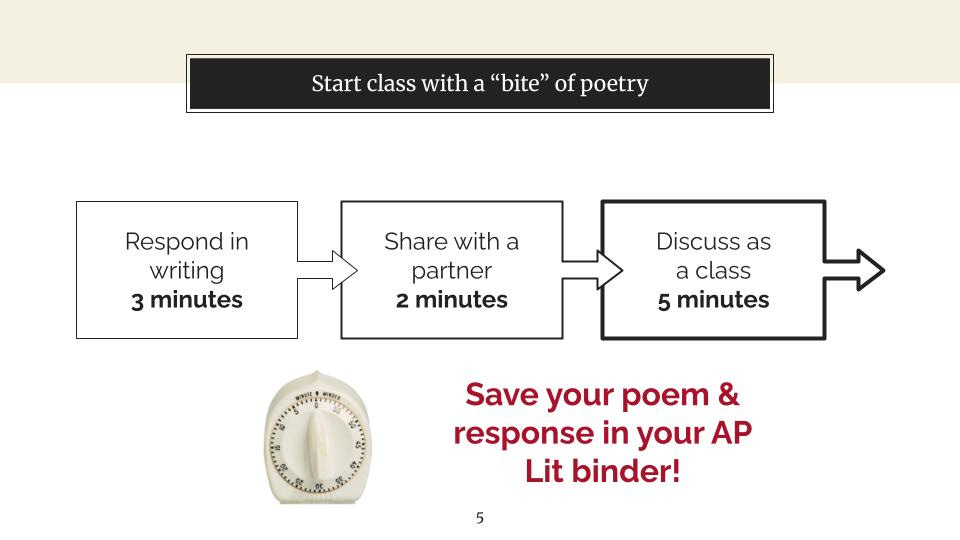
As this is my first year teaching AP Lit, I needed some framework around which to build my class. Rather than teaching a poetry unit, I’m bringing in poetry every day. Students pick up a copy of our daily poem at the beginning of each class. After I read it aloud, I give them 3 minutes to write and respond to the poem on their own. Then they turn and talk for 2 minutes. We wrap up with an informal class discussion for 5 minutes.
My goal is to make poetry less scary. I wrote about Stephanie Burt’s book Don’t Read Poetry in June, and I’m channeling her philosophy with my daily “bites” of poetry. Will my students eventually have to analyze and write essays about poems? Of course! Twice a month this semester, we are returning to a poem we taste-tested and having a full-on “feast,” where we’re building our poetry analysis skills. But I hope that they also learn to approach poetry confidently every day so that when they come across poetry on the AP test in May, it will be no big deal.
Want to give it a try? Grab a FREE copy of my Poetry Every Day slides and a list of 39 daily (for a block schedule) poems for this semester—and then be sure to let me know how it goes or you adapt/improve it!
Onward to September!
Kate
I’m sure I’m using the word incorrectly.
I thought the publishing world was going to be the place to talk about literature and writing every day, but my short stint in the realm after college taught me more about marketing, publicity, and profit margins than I ever cared to know.
This isn’t a spoiler! It’s the first chapter.