

Exit Ticket: February 2026
10 books to read, 36 manic minutes of literary terms, and 1 character therapist for readers and writers alike

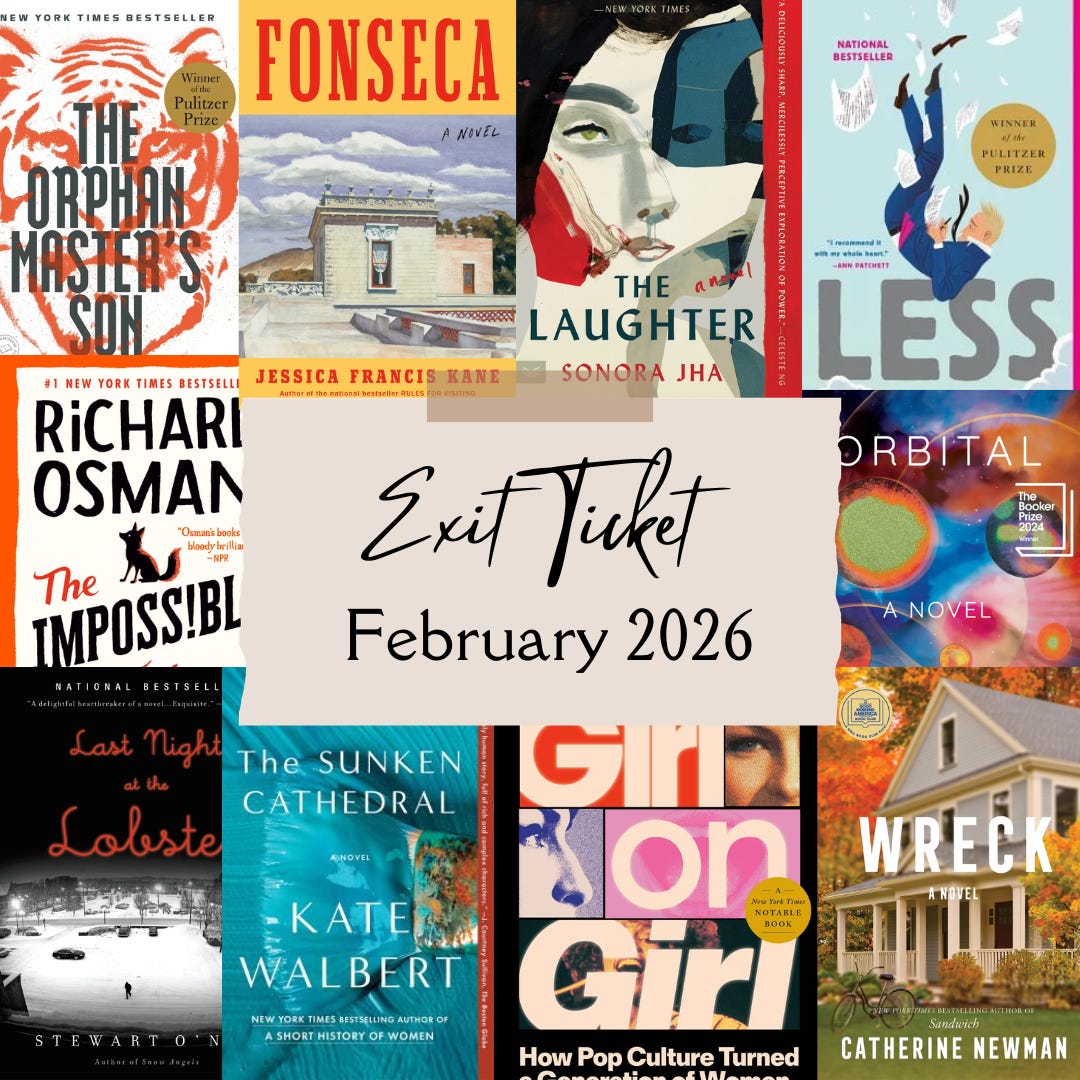
10 Books to Read
The Orphan Master’s Son by Adam Johnson — Since I included this title as a choice for January book clubs, I figured I’d better reread it. Johnson’s ambitious novel follows Pak Jun Do, a North Korean orphan whose fate is determined by inscrutable state forces well beyond his control. At various points throughout his life, Jun Do is a tunnel digger, a kidnapper, a second mate, a communications spy, a prisoner, a diplomat, and an impersonator. But who is he, really? This novel asks: How can your identity be reclaimed when loyalty is mandated by an authoritarian regime? Not only does The Orphan Master’s Son entertain, but its structure also challenges how stories can be told. If you find yourself confused, stick with it. As I promised my students, it does come together at the end (and you’ll never think about canned peaches the same again).
The Impossible Fortune by Richard Osman — This is Osman’s fifth visit to Coopers Chase, the retirement community where Joyce Meadowcroft and her friends in the Thursday Murder Club take down criminals. I love the logic and distraction of whodunnits when I’m feeling overwhelmed, but Osman’s series stands out in the genre because of how he balances his characters’ humor and humanity. While Osman leans into the absurdity of retirees taking down con artists and drug dealers, he also doesn’t shy away from their confrontations with their own mortality. The result is a deeply satisfying series. You should read The Impossible Fortune—but only if you’ve caught up on the first four installments.1
Less by Andrew Sean Greer — Greer may be my favorite P&P author of all time. I laughed through his entire lecture when he came to Denver years ago. Less tells the story of Arthur Less, a novelist on the cusp of fifty who needs to a good excuse not to attend his ex-boyfriend’s wedding. He patches together an extended trip of assorted conferences, fellowships, retreats, and awards of varying literary merit to keep himself busy. Along the way, in between miscommunications and misadventures galore, Less reflects on his life, his art, and his lost love. The audiobook suits the story well because the narrative is so closely rooted in Less’s mind.
Orbital by Samantha Harvey — Twenty-four hours. Six astronauts. One space station. It’s a premise ripe for drama and catastrophe, right? Maybe not, in Harvey’s hands. I met with a friend last week who had recently read Orbital as well. She shared that the book is more of a meditation than a novel, and I agree. There are beautiful moments in which characters gaze at the Earth and contemplate human existence, but the snippets of characterization never fully developed into the narrative I wanted. That said, it’s short book packed with quotable passages. Here’s one of my favorites:
“And now maybe humankind is in the late smash-it-all-up teenage stage of self-harm and nihilism, because we didn’t ask to be alive, we didn’t ask to inherit an earth to look after, and we didn’t ask to be so completely unjustly darkly alone.”
Read Orbital if you’re looking for a slower-paced book that invites reflection.

Girl on Girl: How Pop Culture Turned a Generation of Women Against Themselves by Sophie Gilbert — Gilbert’s nonfiction account of how 2000s “girl power” subsumed 1990s “riot grrrl” feminism is an alternately enlightening and depressing read. Some of her observations felt so true to my own teenage experience that I wanted to pump my fists in the air and scream in validation: I knew it! Others were so disheartening that I wanted to scream in anger. Gilbert argues that the Spice Girl-inflected feminism of the early 2000s was actually regressive: “Girl Power was almost instantly appropriated by brands, who saw in it a powerful new consumer demographic.” As porn aesthetics creeped into mainstream popular culture and reality programming took over TV (and eventually social media), women were “encouraged to embrace their femininity both as passive, glowing housewives and frenetic, dehumanized sex objects.” There’s much to discuss in this book, as evidenced by the lively debate with my downtown book club, but Gilbert’s focus on porn’s influence overlooks other cultural influences, like the evangelical purity culture that pervaded my high school, that also taught girls to hate on other girls.
Fonseca by Jessica Francis Kane — If you haven’t ready anything by Penelope Fitzgerald, you may want to start there first (try The Bookshop or Off Shore). Kane reimagines a few months from Fitzgerald’s life when she took her son to a small town in Mexico after receiving a letter from two wealthy widows. The widows have a large fortune and no heirs, and Penelope Fitzgerald, not yet a novelist, has a failing literary journal, an alcoholic husband, two children, and a baby on the way. Although she doesn’t recall knowing these strange widows, they insist they are old family friends. What Penelope doesn’t count on is a house full of other fortune-seekers who fill the widows’ heads with alternative plans for their money. Penelope’s story is interspersed with excerpts from letters sent to the author by Fitzgerald’s children themselves. Read this book for its immersive setting and its exploration of how real life and fiction intersect.
The Laughter by Sonora Jha — There are unlikeable characters, and there are despicable characters. The narrator of The Laughter falls into the latter category, but Oliver Harding’s story is compulsively readable. The novel opens with a proclamation from Harding, a college English professor:
“It began as lust, that much I will admit. The events and emotions that came after were harder to reconcile. I, Oliver Edward Harding, am not one to trifle with the truth. The thing about truth, though, is that it sometimes reveals itself in the recounting, not in the living. So, while it is still fresh in my mind, I must revisit the events of these past weeks, in particular, the matter of the boy.”
In these opening lines, which set up the novel as Harding’s written account of a troubling incident, Jha indicates that our narrator himself will be untrustworthy. The truth, she reminds us, “reveals itself in the recounting.” As the mystery of “the boy” unfolds, Harding frequently recounts abominably racist and sexist fantasies about his Pakistani colleague, a law professor named Ruhaba. When her nephew comes to stay, Harding befriends him to get closer to Ruhaba. His obsession grows alongside discontent on campus, where students protest the traditional (read: dead white male) canon and advocate for diverse voices. This book will make you uncomfortable, but Jha’s study of white privilege, cancel culture, and misogyny is worth reading.
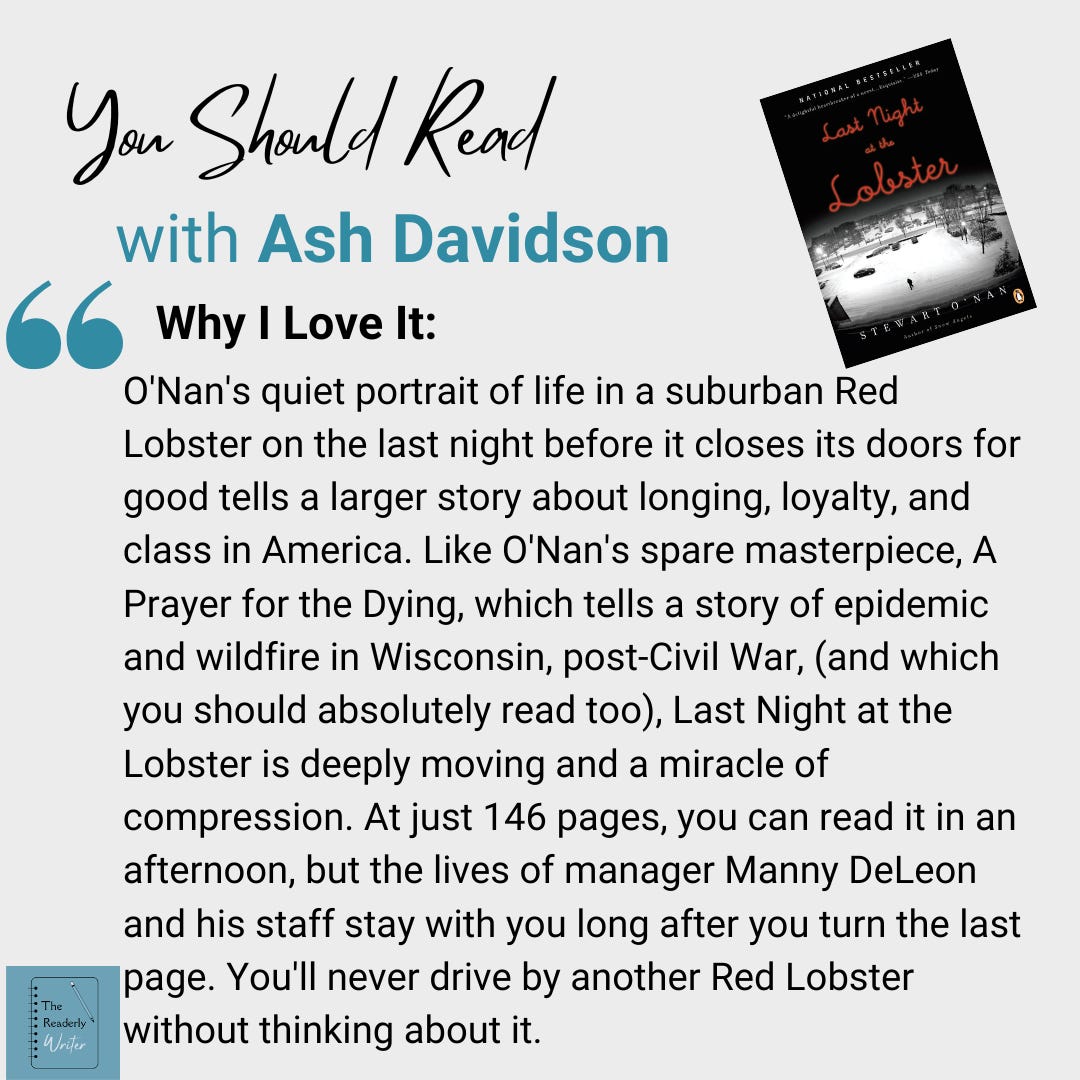
Last Night at the Lobster by Stewart O’Nan — Author Ash Davidson recommended this one, and I enjoyed reading a story that took place over twenty-four hours and also had deep characterization alongside a driving plot.2 As Manny manages a Red Lobster on its final day before closing, he confronts all of the man vs. conflicts you can imagine: a pregnant girlfriend he doesn’t love enough (vs. self), a corporate culture that doesn’t value him (vs. society), an ex-girlfriend he can’t get over over (another vs. self), a power outage (vs. technology), a belligerent employee (vs. man), and an ominous snowstorm (vs. nature). Read this book for a glimpse into the life of a working class man in a small New England town.3
The Sunken Cathedral by Kate Walbert — Read my full review here.
Wreck by Catherine Newman — Perhaps it’s inevitable that because I enjoyed Newman’s first novel about Rocky and her family so much (and I did—you should read Sandwich), this sequel was bound not to live up to that reading experience. More likely, Rocky’s novel-length investigation of a mysterious rash reminded me too much of my own last two months.4 While she’s seeing specialist after specialist to treat her rash, Rocky is also trying not to judge her son, who works as a management consultant, which she views as an ethically dubious career. Unlike Sandwich, which spans a single week, Wreck takes place over the better part of a year, and the extended timeline made the characters’ insecurities feel whinier to me. But still, I’m not sure anyone can match Newman’s ability to write her way from droll observations about menopause in one sentence to poignant reflections on parenting in the next. Read this book with a highlighter because you’ll find plenty of one-liners you’ll want to save for later.
You Should Read SANDWICH by Catherine Newman

Last night I recreated the soundtrack of my childhood: I took my mom to see Hootie and the Blowfish. Growing up, I spent approximately seven thousand hours in the backseat each summer, driving to Minnesota and Arkansas, and Hootie’s Cracked Rear View
36 Manic Minutes of Literary Terms
As my elementary-aged daughters spent Valentine’s Day week prepping treats for their classmates, decorating their boxes, and anticipating their class parties, I felt sad for my high school students. They deserve some festive fun, too! So I planned a full game day for my seniors. In addition to a multiple choice derby race (inspired by this post on Lit and More), we also played Manic Minute to review literary terms.
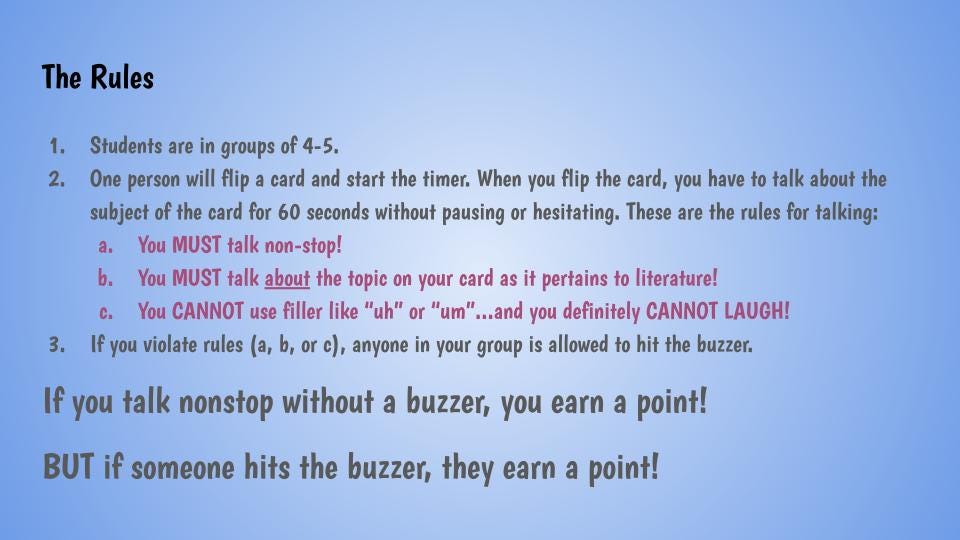
Each group had a stack of 36 cards. When a player pulled a card, they had to talk coherently about that literary term for a full minute without uhh-ing, umm-ing, or laughing. I ordered sand timers and animal sound buzzers, but you can easily play this game without any props. Students can time themselves using phones or watches, and they can slap the desk instead of using buzzers.
This also functioned as a great formative review. As I circulated the room (and sometimes joined groups for a round), I noted the terms that stumped my students. The next week I made sure to review those concepts directly. This game is endlessly adaptable! Grab a copy of my game with AP Lit terms here. Replace my terms with whatever you want to review in your class, and boom! You’ve got an easy and engaging review. (Even better: Have your students brainstorm the terms/concepts.)
1 Character Therapist for Readers and Writers Alike
With manuscript notes from my friend and mentor in hand, I’m about to start my third draft of my third novel (and try not to focus on what number they say is the supposed charm). Reflecting on what is and isn’t working in my current manuscript, I realized that my protagonist’s problems were still fuzzy to me. In the most teacherly move ever, I created a graphic organizer for myself that turned out to be pretty helpful. It’s easy to apply to as a writer or a reader, so feel free to grab a copy of this worksheet (with an example from The Scarlet Letter) here.
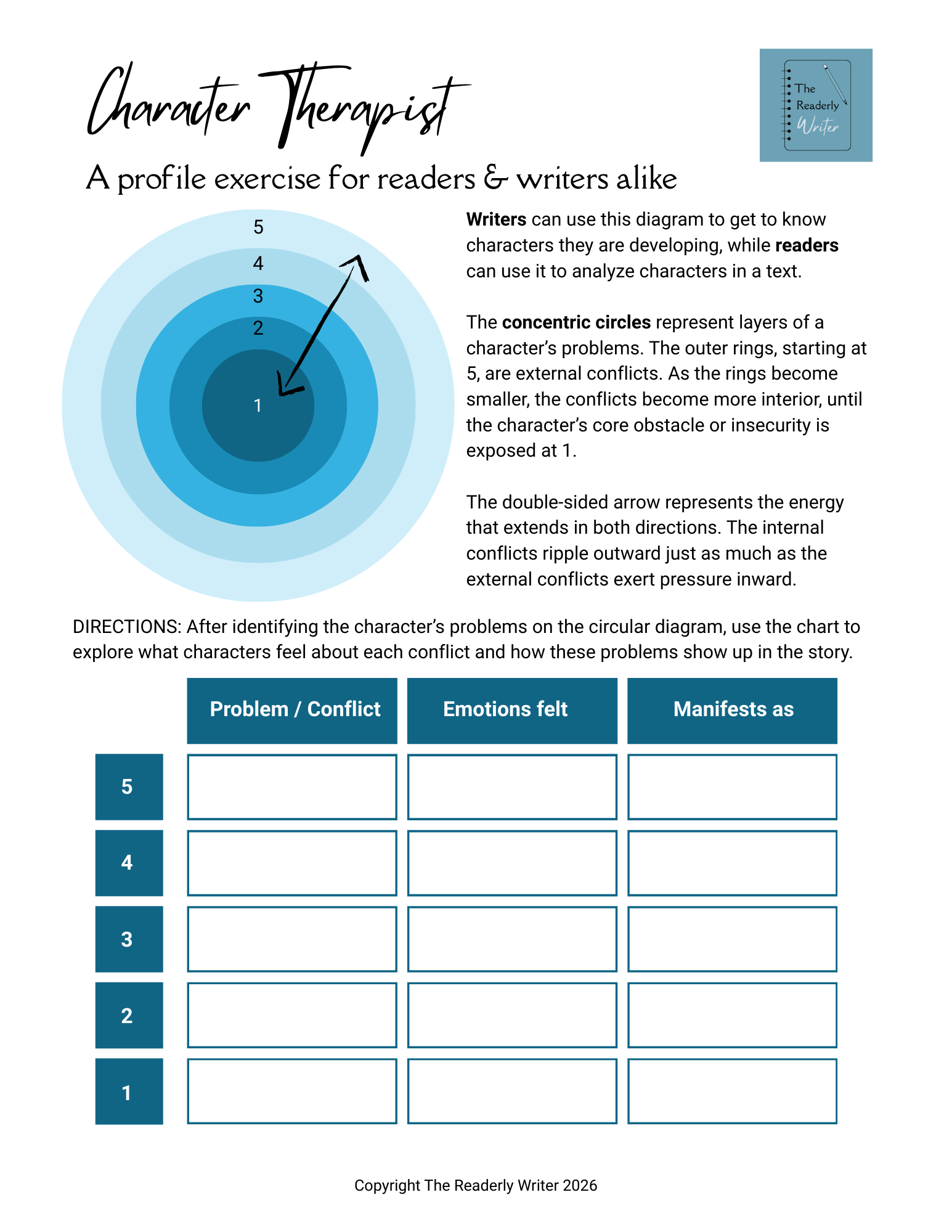
Back in my student teaching days, I used Maslow’s good ol’ hierarchy of needs as a character analysis tool, so I tried thinking about my characters in those terms. But the pyramid structure is too limiting. Characters (and people!) exist in far more fluid states.
I envisioned my protagonist’s problems as a series of concentric circles, where the outer rings represent external conflicts and the inner ones represent internal conflicts. A double-sided arrow runs through the circles because the internal conflicts ripple outward just as much as the external conflicts exert pressure inward.
The Netflix movie adaptation of The Thursday Murder Club is worth watching as well (who doesn’t love Helen Mirren??), but the screenwriters did Bogdan’s character dirty.
2 A.M. at the Cat’s Pajamas by Marie Helene Bertino is also a satisfying twenty-four-hour romp.
Also read this one if you, like me, are living in a weird Twilight Zone version of Colorado where we’ve had virtually no snow. I’ve been running in shorts and t-shirt! In winter! I was honestly salivating over O’Nan’s description of the snowstorm. I would’ve gladly traded places with Manny to shovel the Red Lobster walkway.
After getting strep in January, I developed an all-over rash that was misdiagnosed first as a penicillin allergy and then as scarlet fever before being correctly identified as a special type of post-strep psoriasis. Yay. A lot of good the diagnosis did me because I still look like I have chicken pox, and it’s been almost two months.
I just finished LESS on audio as well. Not my favorite, but a solid novel. I love his blue silk suit :)